
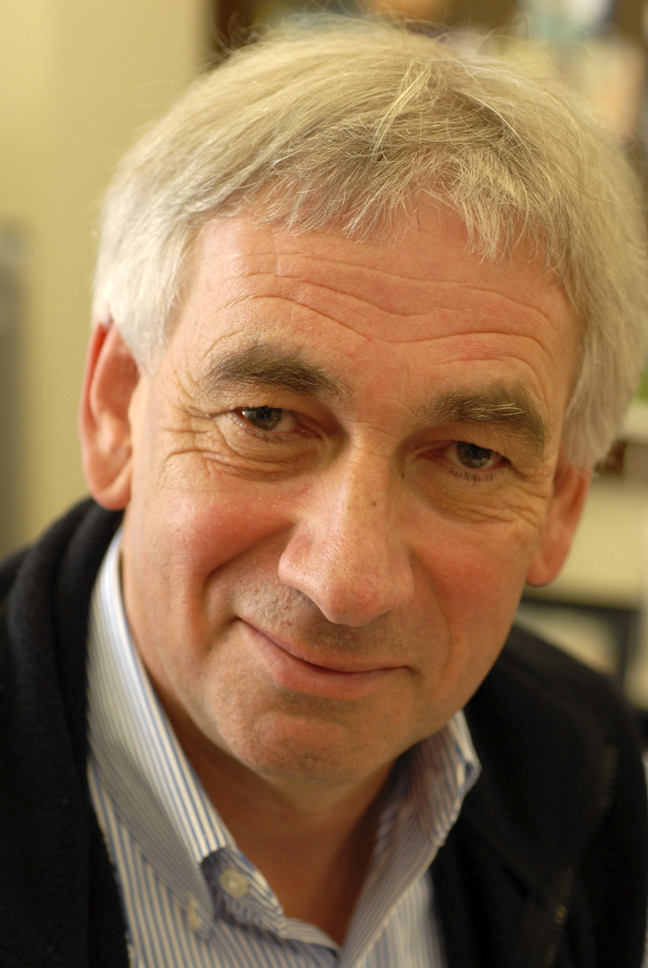
Richard Ellis
Astronomy 249-17, Caltech
Pasadena CA 91125
-
Position: Visiting Associate:
-
On September 1st 2015 I moved to a new position at University College London and my contact
details are on my UCL web page
- However the US communication details below are still functional
-
Secretary: (626)-395-4970
-
Fax: (626)-568-9352
-
Emails: rse@astro.caltech.edu;
richard.ellis@ucl.ac.uk
Overview of Research:
I am working primarily in observational cosmology addressing issues
related to the nature of the world model, the origin and evolution of galaxies,
the growth of large scale structure and the nature and distribution of
dark matter. My recent focus is on addressing the origin of the earliest
galaxies and understanding their role in cosmic reionisation.I am enthusiastic
about the use of new instruments and observational opportunities when
they further the progress that can be made in these areas.
Recent Outreach Activities:
Watch the
Golden Webinar on Cosmic Dawn organised by the Pontifical
Catholic University in Santiago, Chile
Read the
interview on Searching for the First Stars sponsored by the Kavli
Foundation
Watch the two supernova cosmology
teams present reminiscences and anecdotes at Stockholm University as part of the 2011 Nobel Prize
in Physics celebrations (mp4 format)
Read the Scientific
Background on the Accelerating Universe awarded the 2011 Nobel
Physics Prize in part to the Supernova Cosmology Project
(led by Saul Perlmutter )
Listen to an interview
on BBC Radio Wales on how I became an astronomer (light entertainment only!)
Scientific Publications:
Check my scientific output on Google Scholar
Past and Present Students:
Check my proud list of successful graduate students!
Personal Details:
Research Programs:
My current interests fall under 4 main headings:
Gravitational lensing: I have been interested in the role that gravitational
lensing can play in cosmology and galaxy formation since the
late 1980's. I was a member of three independent teams that first detected cosmic
shear, the weak lensing by large scale structure, in 2000. The subject
has advanced enormously, culminating in the successful
launch of Euclid) which aims to
trace the growth of structure from the time-dependent clustering of
dark matter. On small scales I have used strong lensing to separate dark and baryonic matter
distributions in clusters to understand how baryons influence the dark matter profile.
Strong lensing also magnifies and enlarges the apparent sizes of background sources and I have used this
phenomenon to locate distant galaxies and study their internal properties such as
their abundance gradients and velocity fields, as well as determine the faint
end of the galaxy luminosity function at high redshift.
Distant Supernovae: I took part in one of the earliest successful studies to
locate and characterize cosmologically-distant Type Ia supernovae and later joined
the Supernova Cosmology Project .
The resulting "accelerating Universe", recently awarded the
2011 Nobel Prize in Physics, is a bewildering result which has motivated
a number of more ambitious ongoing and future supernovae surveys. I put most of
my effort into examining the validity of using Type Ia SNe for future studies. My
research included examining the environmental dependence of supernova properties as
well as the question of possible spectral evolution such as might arise from changes in
the progenitor composition. This work was undertaken with spectrographs on Keck and HST.
Large Scale Structure: I have been an enthusiastic promoter of multi-object
spectroscopy since the 1980's, working with colleagues to develop early robotic positioners
for the former Anglo-Australian Telescope and several
multi-slit spectrographs. This work culminated in the
2 degree Field Galaxy Redshift Survey which demonstrated the presence of a baryonic acoustic peak
in the large scale distribution of nearby galaxies whose precise measurement at various
epochs is a powerful cosmological probe. I have worked since 2006 with an international team to build
the Prime Focus Spectrograph for
the Subaru 8m Telescope. Now being commissioned
this will undertake a survey of millions of faint galaxies to directly
map the cosmic expansion history to beyond a redshift 2 as well as probe the stellar
halo of our Galaxy and M31. Read the
detailed science case for this remarkable instrument. In 2016 I also led a ESO Working
Group that would take the next logical step towards a 12 meter
telescope with a 3 square degree field. This has now become a major
future project called the Wide
Field Spectroscopic Telescope. Check out a recently completed Scientific White Paper.
Galaxy Formation and Evolution: I have been interested in studying the properties
of distant galaxies since I was a postdoc in the late 1970's. I have used the combination of HST images,
Spitzer photometry, ground-based K-band imaging and, most of all, Keck/VLT spectroscopy to
better understand the origin of the wide diversity of galaxy morphologies. Key questions
I am working now on include the luminosity evolution and mass-dependent assembly of galaxies over the redshift range 7 to 15,
tracing cosmic reionization through deep JWST imaging and spectroscopy. Closer to home I also study the onset of ordered
rotation and surprisingly compact nature in distant spiral and elliptical galaxies respectively.
Recent Review Articles and Talks:
`Gravitational Lensing: Einstein's Unfinished Symphony'
(Invited Review: United Nations `Year of Light' Series, Contemporary Physics)
`Cosmic Dawn: Studies of the Earliest Galaxies and
their Role in Cosmic Reionization' (Invited Review: 26th Solvay Conference, Brussels October 2014)
Formation & Growth of Galaxies in
the Young Universe (Conference Summary, Obergurgl April 2014)
`A Century of Redshift Surveys' (Invited
Talk: Origins of the Expanding Universe)
`The Global Impact of ESO' (Invited Review),
ESO's 50th Anniversary, Garching 2012
`First Light and the Faintest Dwarfs'
(Conference Summary), KITP, Santa Barbara 2012
`New Horizons at High Redshift' (Conference
Summary), Cambridge 2011
`Gravitational Lensing: Einstein's Unfinished
Symphony' (popular talk)
`Cosmic Dawn: The Search for the First Galaxies'
(popular talk)
`Early Star-Forming Galaxies and
the Reionisation of the Universe' (review published in Nature November 4th 2010)
`The Origin of Galaxies' (Conference Summary (ppt), Obergurgl, Austria Dec 2009)
`The UKIRT Success Story' (opening
talk at `UKIRT at 30' (doc), Edinburgh Sep 2009)
`Gravitational Lensing: An Unique Probe
of Dark Matter and Dark Energy' (invited popular review to celebrate 350 years of Royal Society (doc), Aug 2009)
`The Quest for Giant Telescopes: Four Centuries
of Challenge and Scientific Discovery' (Keynote Talk (ppt) at 2009 APS Meeting Denver, May 2009
`Scientific Opportunities
for 30 Meter Class Optical Telescopes' (invited talk (doc) at New Visions 400, Beijing 2008)
`Panoramic Views of
Galaxy Formation and Evolution' (Conference Summary (pdf), Hayama, Japan, Dec 2007)
Observations of the
High Redshift Universe in `First Light' (Saas-Fee Lectures (pdf), Apr 2007)
Latest Refereed Papers (2024 submissions)
Lya Profiles of Extreme
[O III] Emitting Galaxies at z > 2: Implications for Lya Visibility
in the Reionization Era
The Rise of Faint, Red AGN
at $z>4: A Sample of Little Red Dots in the JWST Extragalactic Legacy Fields
Lensed Type Ia Supernova
"Encore" at z=2: The First Instance of Two Multiply-Imaged Supernovae
in the Same Host Galaxy
Glimmers in the Cosmic
Dawn: A Census of the Youngest Supermassive Black Holes by Photometric
Variability
Galaxy Build-up in
the first 1.5 Gyr of Cosmic History: Insights from the Stellar
Mass Function at z=4-9 from JWST NIRCam Observations
JWST PRIMER: A new
multi-field determination of the evolving galaxy UV luminosity
function at redshifts z=9-15
Lyman alpha emission in
galaxies at z=5-6: new insight from JWST into the statistical
distributions of Lyman alpha properties at the end of reionization
Spatially Resolved Galactic
Winds at Cosmic Noon: Outflow Kinematics and Mass Loading in a Lensed
Star-forming Galaxy at z=1.87
Latest Refereed Papers (2023 submissions)
CIII] 1909 emission as an
alternative to Lyalpha in the reionization era: the dependence of
CIII] and Lyalpha at 3~z~4 from the VANDELS survey
The galaxy UV luminosity
function at z=11 from a suite of public JWST ERS, ERO and Cycle-1 programs
Deciphering Lyman-alpha
Emission Deep into the Epoch of Reionisation
Spectroscopy of CASSOWARY
gravitationally-lensed galaxies in SDSS: characterisation of an
extremely bright reionization-era analog at z=1.42
A NOEMA molecular line scan
of the Hubble Deep Field North: Improved constraints on the CO
luminosity functions and cosmic density of molecular gas
Photometric IGM tomography
with Subaru/HSC: the large scale structure of Lya emitters and IGM
transmission in the COSMOS field at z=5
Current Committees
Scientific Advisory Committee
Kavli Institute for Astronomy and Astrophysics, Beijing
Scientific Advisory Committee
ORIGINS Cluster, Munich
Royal Society
Research Professorships Panel
Editorial Board
Contemporary Physics
Caltech Teaching
Ay 123 Structure and Evolution of Stars
Ay 211 Extragalactic Astronomy
Ay 124 Structure and Dynamics of Galaxies
Page maintained by Richard Ellis rse@astro.caltech.edu
Last modified: 16th March 2024